Showing posts with label assignment. Show all posts

Sunday, March 17, 2013

Wrapping Up Our Peace Corps Service - COS Conference

Cathy:  There has been a long time gap between now and our last blog post. Steve and I made the decision to leave three months earlier than the "assigned" June 10 exit date. We could not write about our plans because they needed to remain secret. We also wanted to be sensitive to people who might read the blog.

Because we both had been in country with (what can only be termed) bad assignments, we felt unhappy about our Peace Corps service. This was true for the majority of the time we were in Belize. My work with POWA had been terminated officially in early February 2012. I found things to do in Dangriga - taught Health and Family Life Education to kids in Standards III, IV, V, and VI at three schools, started the girls club, and led the Zumba exercise classes. Those were all good small projects (they averaged about 8 hours a week), and I derived a lot of satisfaction from them.

Of the two of us, Steve had the least to do. Steve was taken off his assignment at the Polyclinic in October 2011, and then reassigned to the same project about February of 2012. Unfortunately, nothing changed regarding the work partners commitment to working with a PC volunteer was practically nil. Steve spent very little time in contact with the people there, less than 3 hours a week, despite trying to "drum up" work many times with many different organizations. As he got to know the Cayetanos, he enjoyed doing the woodworking project for them. He also helped Anthony, the young boy who lived downstairs, with his homework almost every night.

Then in March of 2012, Steve was asked to participate in rewriting the Community Health Worker training manual, and he brought me on board. Writing that manual was quite a challenge, and we are both extremely proud of our work with the Ministry of Health. We completed the last of the drafts in January of 2013. Although we were challenged and happy with our work product, the work was not fulfilling in the way that working directly with Belizeans would have been. Basically, it was a sit-down job, researching, writing, and creating illustrations. Contact with the MOH was primarily through email and telephone.

Once the "book" was complete, we felt it was time to come back to the United States. Our country director was very understanding and sympathetic to our situation, and was able to obtain an exit status of "Interrupted Service" which will allow us to work with Peace Corps again if we ever wish to do so.

So . . . these last entries are a short recap of our last few weeks in Belize. We'll start with a description of our last official Peace Corps meeting - the COS Conference.

Steve:  The Close of Service Conference is a time for reflection of what our service in Belize has meant to us. It is also a get together with all the volunteers and all of the Peace Corps staff people for some “thank you” and some “good-bye” talks with each other.

It started with a cook out at the home of our country director. This was an all afternoon thing, and I think we all ate way too much delicious food. The next day we caught the bus to Cayo (San Ignacio Town) and checked in at the Cahal Pech Resort. It is right next to the Mayan archeological site with the same name. The manager of the resort smiled a special smile each time she told Cathy and me that we had the honeymoon cabana.

We had sessions to talk about our milestones as well as sessions about making the transition back to life in the US with gainful employment for some and graduate school for some. There was also a session where the top staff people went around the room and said something special about each of us in the volunteer staff.

Cathy participated in a role play as an interviewer.

We also had a surprise for the staff people. At lunch the last day we staged a flash mob. The director thought at first we had lost our minds. We used a mash-up of four songs (Hot Cheetos and Takis, Summatime, Gangnam Style, and We Are the World 25) that we could sing and dance to. We finished with “We are the World” after we went out and fetched each staff person to come and join us in a circle.

Twenty-five PCVs plus staff
Basically the entire three days were one gigantic “warm fuzzy” for everyone with lots of hugs and some tears (of happiness).

The Ambassador and his wife joined us one night for dinner.


Mrs. Thumalapally is every bit as qualified as her husband!
These are the education PCVs who worked with Mrs. T.


Our good friend, Shaz, participating in the "fun fact" exercise.

People participating in the photo scavenger hunt.

Some fun during a break


Friday, August 31, 2012

Another Kind of Peace Corps Adventure - Just a Taste

Everyone's Peace Corps experience is different, but Steve and I envisioned that we would live in a small village, in a hut with no electricity or running water, and hoped to become accepted community members during our 2-year stay. Of course, that is NOT the environment we are in.

I was lucky enough to be invited to help Mallory Begley, a PCV living in Pueblo Viejo, with her kids' summer camp. Pueblo, as it's called by Mallory, is a small Mayan village of about 600 people. It's located in south Toledo district, close to Guatemala. I took the James Bus Line to the village of Dump (yes), then completed the trip on a local village busline - Bol's to Pueblo Viejo. The ride to PV is quite rugged, and slow, but the view is so beautiful that I didn't notice that it took so long to go 16 miles.

From Dangriga to Pueblo Viejo by bus - about 5 hours

The climate is delightful - warm, but not hot, cool in the evening.Mallory was waiting for me. Her house is right on the village road. I guesstimate her house at 300 square feet, with one very large room and two tiny bedrooms. The good latrine is out back down the hill a bit. One of the village wells is right across from her house, so it's easy to "back water" (carry water on your back) when she needs it. There is no electricity. There are wood sides and a thatch roof about 25 feet high. Very picturesque.

Beautiful countryside
It was almost dark when I arrived. She wanted to visit a family before it was too late, so we went to Miss Antonia's house. Just like here in Dangriga, visiting etiquette requires that you hail the people as you approach the house. Nobody knocks or touches a house without being invited to enter. Mallory will be the godmother of Miss Antonia's youngest baby, and she wanted to chat with her about the christening and some other matters. They fed us with a specialty of the area, green corn. The corn is ripe, but it's boiled in the green husks, and thus the name. It was very dark by then, but they had a little light coming from another room, a fluorescent bulb powered by a stored energy from a solar panel. All the other children were there, and one of the daughters I had met already at the GLOW camp last month.

When we arrived back at Mallory's house, two boys were waiting for us. The older boy, Filamon (that's a phonetic spelling), about 14, wanted help with his homework. His brother Joshua was about 7, and he was just along for the fun. He and I played cards while Mallory and Filamon worked on the science homework.

Homework help. Mallory has 2 chairs and some buckets for
seating. Small homemade kerosene lamps provide some light,
often supplemented with flashlights and headlamps.
It was 10:30 by the time we got to bed - LATE. She carefully checked around the mosquito netting and under the mattress to make sure there were no scorpions. It rained hard during the night, so getting up to pee was not even close to fun. Otherwise, I slept very soundly in the quiet of the countryside.

The next morning, I tried several new things. First we bathed in the river, in our clothes. Mallory also washed some clothes - with laundry detergent and a rough brush. Underwear, skirts, socks all get the same treatment. There is no such cycle as "delicate." She was able to change into clean clothes there at the riverside. I could not manage it - everything was sticking and I couldn't maintain modesty. So I just left on the clothes I bathed in and planned to change back at the house. On the way back, we stopped at another family's home, the Salams, and they gave us a delicious breakfast of beans, tortilla, boiled egg, salsa, and avocado (pear). They also served a very weak coffee with lots of milk and sugar. Even kids drink the coffee drink.

By 8:00 o'clock we were back at Mallory's home doing other morning preparations. Two other Peace Corps volunteers arrived to help with the camp for the day. Jay Schultz lives in a nearby village, Forest Home, in Toledo, and works with education. PCV Ellen came all the way from Belize City where she also works with education, special needs children.

Mallory had planned the summer camp with very full days, and it was very well-organized. But as with any big project such as this was, there were some snags. The man who was to talk about recycling, clean earth and organic gardening was not able to be there by 8:30. I started the day for them with some fun Zumba. They were hesitant at first, but as they heard the music and saw how easy and fun it was, they joined in - con gusto! I really hammed it up and so did the other PCVs, so the activity was a great success!
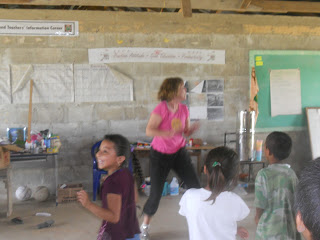
Mueve la Colita!

Gasolina

Santa Maria (stretch)

After Zumba and the morning presentation, we had a little time to kill, so we had some fun icebreakers and games.

Musical Chairs
Princess Pat - a real favorite with the kids.
We dined in style at lunch with Mallory's special pad thai rice!

After lunch, it seemed like the afternoon flew by. Ellen entertained the kids with magic card tricks, and gave them a very active lesson in self-defense.

HOW does she do it?


We finished off the day (for the campers) with a visit to the falls where they could have a fun swim.

Boys get to strip down to their underwear. Girls go swimming
in their dresses.

One of a series of waterfalls in this area.


The day didn't stop for us at 4:00 when camp was over. Back at the house, I took a bucket bath in her little bath house; it was very refreshing, and definitely the way I would go if that were my permanent place to live. LOTS of people came by the house. Low key visiting.

Then we went to visit her old host family. As soon as we went in, we sat down to make corn tortillas. I joined in, and did a lousy job, looks-wise, but they tasted OK. Scrambled eggs, beans, tortilla, hot sauce (Marie Sharpe's and some homemade), and pear! Also coffee drink. We sat around for awhile after eating and I looked at a picture album - parents and 11 kids - then we left. The 2 boys were waiting again for homework help. Replay of night before, except it was math help.

We fell in the bed after 10:30 and slept HARD till 6:00-ish. We at breakfast AT HOME - toast and pear. Kids were at the house by 7:00, so it was hard to do everything since there was NO privacy.

Time to start Day 2 of the camp week. The principal of the school taught the kids how to sing the Belize National anthem in Mayan. Well, some of them already knew the words, but other's didn't know it at all. I believe there will be something on television with the kids singing.

Then they made sock puppets. SO cute!


Lunch was back at the Salams' house, the people who fed us the first morning. It was the 2nd birthday for their 2nd youngest baby, and they cooked big-time to celebrate. Rice and beans, cole slaw, stew chicken, tortilla, COLA (now that is very special for these folks) and something else I can't remember. There was a houseful of people for lunch, including several teachers from the school where the camp was being held.

Domingo Salam and his family (one of the son's is not in the
picture). The boy in yellow, Imer, is the birthday boy.
Afternoon was more Zumba (the kids were VERY enthusiastic this time), and water balloon fights. We made more than 100 water balloons which disappeared in a nano-second. Not really. Mallory made up some crazy game that the kids understood, and they played with them for at least 20 minutes. Even Mallory couldn't believe that they figured out the game. SHE didn't even understand it ;-)


Just a few other things to describe.


  • Pigs are kept by people, but they don't do a very good job of keeping them penned. Here's a picture of a sow and her piglets as they got caught in the school fence.


Pigs lost inside the school fence. In the background you can
see Mallory's house.

  • We had MORE visits at Mallory's house and ANOTHER meal with a family on that same night. Shame on us - we turned the lights off so that the boy who wanted homework help would have to go home to get help. I guess Mallory didn't think that offering to help him was going to be a full-time job.
  • I saw a scorpion crawl out from under the mattress, and didn't have a heart attack.
  • Throughout the time I was there, I tried to place myself in that situation. I think I would be really happy to work in a setting such as that one - muddy, slippery footing, always wet, living in the fishbowl, afraid to go to the bathroom. I believe I could acclimate and enjoy!
  • The Mayan people I met a beautiful people, proud of their heritage (as are the Kriols, Garifuna, Mestizo, etc.), and they seem to be very cordial and polite.
Finally, I admire Mallory SO much for her initiative in this project. She wound up with very little help from the school faculty (there WERE some who helped). She was everything that a PCV is supposed to be - flexible, enthusiastic, integrated in the community, resourceful, concerned about people's well-being. 

I can barely keep my eyes open this evening. It was a great trip.


Sunday, March 18, 2012

Mostly Ups

If you've been keeping up with this blog, you know that Steve and I have been struggling with our time here - psychologically and emotionally, much more than any physical or financial hardship. Our original work assignments were not well-vetted, so we have been engaged in very little meaningful work. So many current and retired PCVs have told us that we would need to be here at least a year before things really shape up. Unfortunately, that's assuming that the work assignment is a good one. Nevertheless, Steve and I trudge ahead, routinely encouraging each other and looking for any glimmer of positive developments.

This past week was about the same for Steve. We make jokes about how early Steve gets back from work. He leaves in time to get to the clinic by 8:00, about a 20-minute bike ride,and seeks out his work partners to see what's going on. He's usually back before 10:00. Friday was a record; he made it back by 8:30. 

Next week promises to be a big step up. Steve will head up a big new project - updating and restructuring the training manual for Community Health Workers. It's a great opportunity and so perfect for him. I will be involved, too, since I have lots of experience writing educational materials and training manuals, as well as a background in adult education. Our "get organized" meeting is Tuesday. A Peace Corps Program Manager from Honduras will kick start the project. You may recall that all PCVs were sent home from Honduras, so this guy is on loan to PC-Belize for a month or so.


For me, last week was pretty good. I taught my regular HFLE classes and they all went very well. The kids in my classes have told other kids in their schools and neighborhoods about me. It's pretty fun to be walking or riding around town and hear, "Miss Cat!" I don't necessarily know the name of who's hailing me, but it warms me up to hear the hello and exchange a smile. I also taught Zumba twice, both times with large attendance. Yay! 

Kids across the street play most afternoons.


The Dangriga Youth Alive group met again. The Dangriga Town Council will join forces with DYA to create an even bigger and more diverse Easter celebration - a day longer (add Saturday), and a longer day (Sunday night concert/dance from 10-3). Yes, folks, I am helping to create my own worst complaint, the loudest, awfullest, all-night-keep-me-up musicfest :-(  OK, it's for a good cause. The Town Council will pay for all the advertising (DYA had NO budget for that), build a shed for vendor booths, pay for the big tent, and provide some other games. 


Aidra and I are planning how to cut and use this board
for some carnival games
Everybody benefits! The Town Council benefits by promoting Dangriga as a fun place for Belizeans (most people from Dangriga would go somewhere else for the holiday weekend) and tourists, and DYA also promotes its name and goals while raising money for high school scholarships. 

Dare I hope that something more permanent will work out for me with DYA? Fingers crossed. They are a newly-formed group that is just developing their organization and mission. Peace Corps and I disagree on a fundamental element of project assignment. PC management believes that work in Belize needs to be through the various ministries of government, and I think working through 
grass-roots efforts is best. I certainly understand the need for approval at high levels. Peace Corps can't just traipse in to a country and haphazardly try to help with development. But for the volunteers, it sure is easier to actually GET WORK DONE and feel useful working with very small groups. Just my two cents.


Finally, I thought I'd include an excerpt from a letter written by my friend, Alex. I knew her from when I volunteered at Family Violence and Rape Crisis Services in Pittsboro, NC. She was a paid staff counselor there. She and her husband came back last fall after their Peace Corps service in Vanuatu. She shared these words of wisdom with me. (P.S. If I have already included this in an earlier entry, I apologize. It's good advice two times.)


Thanks for the email--We are in the throes of readjusting to American life and I am so far behind on writing friends and even seeing friends in America.

The two most shocking things of being back in the states are how cold it is here and how stressed out everyone is. I am used to being the most high strung member of my community (along with Lucas), but compared to the average American, I am SO LAID BACK! Unbelievable! I really miss how chill the islands are (although at the time, I wish people had a little more fire under their asses to do ANYTHING at a faster rate).

Oh, Peace Corps. Towards the end of our service, Lucas laid down on our bamboo bench for a week and fell apart over how unsatisfying the job aspect of Peace Corps was for him. he was originally a business vol and really went into health because there was nothing for him to do that he would consider ethical as a business vol (he did lots of small business individual advising and was there long enough to see anyone who was doing something remotely innovative fail because of their family relationships). capitalism and a tribal community don't mix and the good things about the tribalism where we were outweigh the good things about capitalism...even if there was strong tribalism, people couldn't and wouldn't work together on community projects for various reasons: All of this caused my poor husband to have a breakdown for a really sad and ugly week...Lucas' hope of a meaningful project died and it was really hard to watch.

But, what we did take away from it all is that we caused no harm. We know volunteers that have done big projects that will surely fall apart when they leave (or soon after) and that did nothing to empower communities (in fact, having the opposite effect). They feel better about themselves, but I wonder about the unintended consequences they left behind.

we did do a whole lot of intentional nothing (we could have made ourselves very busy, but it didn't go with our value system of doing work with the community not for the community) and the only thing that I wish I would have done differently is offered more things like computer classes, adult literacy and English classes, reading classes with children, Spanish classes, anything like that. Lucas wishes he would have done PACA (I think it's a waste of time). Anyways, we did have periods of extreme busy and then absolutely mind-numbing nothing. I think most folks in the developing world are okay just taking care of the daily acts of living (which can be so time consuming), and all the other stuff isn't that important. Who knows. 

Anyways, I'm sorry for you guys--it's a tricky spot to be in, I know.

When we were leaving Vanuatu, there were about seven of us leaving at around the same time--we all ended up going out to dinner one night and all of us had different periods of really hard times in our service. 

This is what we could all agree upon: 
1. Peace Corps kicked our asses in ways we had no idea was possible--a lot of us at the table were very used to being competent professionals that were used to some degree of mastery; we were all humbled as all of our expectations for what we could actually do were higher than what happened.


2. We had all grown: there were people at our table in their 70s and a 24 year old and we all felt stretched and challenged.

3. At some point in our service, we all HATED Vanuatu.

4. And we would all do it again (not take it back) and would recommend it to anyone who was interested. 

So that's been our view from the end. All those stupid cliches are true about it being the hardest job you'll ever love.

I miss Vanuatu now being on the other side of it all and I even miss the laid-backness that would drive me so NUTS!! 


*************************************************************

The requisite puppy pictures. FuWe Dog can SLEEP!


Wednesday, October 27, 2010

NOW we've got something to talk about!

Peace Corps invitation to serve arrived today - one letter addressed to both of us, along with a very large packet of information.

Country:  Belize
Program:  Healthy Environments
Job Title:  Rural Health Educator
Dates of Service:  June 11, 2011 through June 11, 2013
Orientation Date (in the US):  March 23, 2011
Pre-Service Training (in Belize):  March 24, 2011 through June 10, 2011

[Peace+Corps+Belize+sign.jpg]We're both feeling REALLY good about this.  We're not sure why we got such a wonderful assignment - I mean, really - BELIZE.  It's beautiful.  The official language is English.  Formerly British Honduras.

Now reality - it's a very poor country, except for small portions of the coast where the tourist trade contributes to the economy.  We'll be stationed in a rural area, most likely with no running water or electricity.  And we'll need to learn an indigenous language.

Time to dig in and learn about our future home :-)  We'll share more right here.  Cathy