Showing posts with label video. Show all posts

Thursday, July 19, 2012

Another Exciting Week


The last 10 days have been busy. Last Saturday we went to a workshop for community health workers from Cayo District. The purpose of the meeting was to test-teach the prenatal chapter in the women’s health module that Cathy had written. She did most of the teaching with help from one of the HECOPAB (Health Education and Community Participation Bureau) educators. The training activities seemed to go over well. We have yet to see the scores from the test we gave before and after the sessions. It will be nice to know if the training was effective. The people certainly seemed to like it. We got great feedback about language and cultural nuances that need to be changed in the manuscript.


Arlette Sheppard is at the front, asking for feedback about specific
wording in the manual.
The facility, Camalote Camp, is very nice and perfect for meetings.
From left to right, Arlette, Cathy, Rose, and Christina (Rose and
Christina are HECOPAB educators)

One group presenting

Another group presenting with Rose Anderson supervising

A second room (air conditioned!) where we worked
My work partner, Mr. Tillett has been working furiously with me on a video about child nutrition and Incaparina. The Ministry of Health He had asked him to give a presentation at a  meeting in Belmopan. He gave the presentation even though there are still improvements to be made to the video. According to what he said, it was very well received. They have asked him to finish the voice-over parts and then publish it to be widely distributed on DVD. I am proud, and very happy for him to get recognized for the good things he is doing for children in our district. It is great to be a part of that. 

Tylon Tillett working on the voice-over for the video
We are both very grateful to our friends and relatives who have enlivened our lives with care packages of goodies. Jeannie and Larry, Joyce and Holly, Toni and Stacey, Carol and Nancy, and Charlie - THANK YOU! We realize that it is expensive to send things and that you have to wait a long time for stuff to get here before you hear the delight in our voices when we offer our heartfelt thanks.

Sunday, March 4, 2012

Leap Year Day - Save our Barrier Reef!


Belize, the "Jewel of Central America," is rich in resources. At the top of the list is its natural beauty, including the coral reef situated off the coast, the second longest reef in the world. Every year thousands of tourists come from all over the world to explore the reef and enjoy the hospitality of Belize. Tourism is one of the country's largest industries. As the country's infrastructure improves and grows, tourism will continue to grow in importance.

Belize oil pumping station Spanislookout
Pumping station at Spanish Lookout
Another resource, although not so plentiful, is petroleum. One company, Belize Natural Energy, began exploring in the Spanish Lookout area in 2002, and now produces about 5,000 barrels a day. Before that, many companies had unsuccessfully explored for 50 years. The crude is processed here, but all of the oil is exported. None of the owners of the company are Belizean and they hire very few Belizeans. The sole benefit of BNE (other than some small grants to various local groups, such as POWA) to the country are the corporate revenue taxes.

According to an article on Belize.com,
"Most of Belize’s 8,867 square miles of territory and much of the waters offshore have been allocated out in petroleum concessions to 18 different companies with a range of foreign shareholders from as close as the USA and as far off as Taiwan and even a local gambling den," and "Princess Petroleum Limited, belonging to the owners of the Princess Casino, has a contract to explore 1 million plus acres of Belize for oil. The license is mostly offshore, but also some inland exploration. The company is allegedly well connected with local politicians of the ruling United Democratic Party." (Read the entire article.)


So now to get to the focus of this blog entry - offshore drilling. The government is promoting offshore exploration and drilling "for the benefit of the people of Belize." Enter Oceana, an international organization dedicated to protecting the oceans and natural oceanic resources of the earth. They have been present in Belize for a long time, focussing on overfishing, habitat destruction, pollution and climate change. Barrier reef protection is at the top of the list. More than 20% of the Belizean population derive revenues because of the barrier reef. Regarding offshore drilling, Oceana, in partnership with the Belize Coalition to Save Our Natural Heritage, has been advertising vigorously since before Steve and I arrived in Belize last March via posters, radio and TV commercials, newspaper articles and canvassing to spread the word about the issue, and the dangers to the barrier reef. (Read Oceana's overview.)

In 2008, the Belize legislature passed a law allowing people to bring issues to a referendum. The petitioners for a referendum must collect signatures from at least 10% of the registered voters (about 18,000 people) for the issue to be allowed on the government ballot. This is the first time the new law has been tested. Oceana turned in close to 21,000 signatures. When the signatures were reviewed by the ministry in charge of elections, more than 8,000 signatures were rejected.


This was, of course, a big setback. They were expecting some problems with duplicates or some whose voter registration was in doubt, perhaps up to 1,000, but not with almost 40% of the names. The group is following up by requesting documentation on why each signature was rejected. In the meantime, Oceana's next step was to announce that a People's Referendum would be held on Wednesday, February 29. The vote would be funded completely by Oceana and the Belize Coalition to Save Our Natural Heritage.

One of the polling locations in Dangriga. More than 3700 people
voted from Stann Creek District.
The turnout was impressive (more than 29,000 voters), and the vote, not surprisingly, was against the offshore drilling by about 96%. Of course, it was an unofficial vote, and so holds no weight with the government. However, Prime Minister Dean Barrow went on record yesterday to say that he can't ignore the fact that so many people made the extra effort to voice their opinion. He said that if re-elected, he "personally would be prepared to support the Government sponsoring the referendum to be held at an appropriate time after we would have allowed for a full-throttle debate during which people will not just hear from one side."
I have met NO one here who is in favor of offshore drilling. Of course, I live here on the coast of Belize, so that's not surprising. I have read some articles quoting some who support the drilling initiative.

General elections will be held this Wednesday, March 7. As Peace Corps Volunteers, we do not get involved in politics. For our safety, we will be in a status of Alert and Stand Fast for March 6-8. Focus this week will be on the politicians, not the barrier reef. But I'll keep you updated on this important issue.


Tuesday, November 29, 2011

Settlement Day!


(This is Cathy.) Settlement Day was the best celebration yet! Here's a quick rundown on the Garifuna people from Wikipedia:

The Garinagu (singular Garifuna) are a mix of African, Arawak, and Carib ancestry.[11] More precisely, the average Garifuna is 76% Sub Saharan African, 20% Arawak/Carib and 4% European.[42]
Throughout history they have been incorrectly labelled as Black Caribs. When the British took over Saint Vincent after the Treaty of Paris in 1763, they were opposed by French settlers and their Carib allies. The Caribs eventually surrendered to the British in 1796. The British separated the more African-looking Caribs from the more indigenous looking ones. 5,000 Garinagu were exiled, but only about 2,500 of them survived the voyage to Roatán, an island off the coast of Honduras.
Because Roatán was too small and infertile to support their population, the Garinagu petitioned the Spanish authorities of Honduras to be allowed to settle on the mainland coast. The Spanish employed them as soldiers, and they spread along the Caribbean coast of Central America. The Garinagu settled in Seine Bight, Punta Gorda and Punta Negra, Belize by way of Honduras as early as 1802. However, in Belize 19 November 1832 is the date officially recognised as "Garifuna Settlement Day" in Dangriga.

Dangriga geared up early, at least a week ahead of town. There were special ceremonies throughout the week. One celebrates TV Ramos, a teacher, activist, and philanthropist who worked for more recognition of the Garifuna people of Belize, and was instrumental in getting Settlement Day made a national holiday. All primary and high schools held historical and cultural events.

On Friday morning, day before Settlement Day, the primary school kids gathered at Alejo Beni Park (yes, the park where I hold my Zumba classes). They had their own re-enactment of the landing, followed by lots of speeches, and two "pep" talks from pop stars - Titiman Flores (YouTube of Flores) and another guy whose name I don't remember. They encouraged the kids to pay attention to their heritage and don't lose the language, beliefs and culture of the Garinagu. Few of the kids heard it. They talked all the way through! Or were listening to their iPods (probably to Lova Boy).

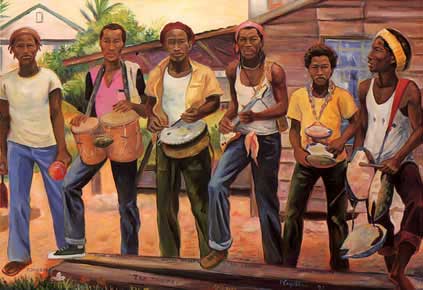
Later in the afternoon we took Carol and Nancy to the art gallery of Pen Cayetano. He is a well-recognized artist and musician from Dangriga. His wife, Ingrid, is also a textile artist. She is originally from Germany, and they both lived in Germany for 18 years, but came back here a couple years ago. I love both their works. Pen is also credited with "inventing" punta rock music. His band, The Turtle Shell Band, has several CDs, and they use turtle shells for drums.
Turtle Shell Band - picture painted by Pen Cayetano

Pen Cayetano with Nancy and Carol, in the backyard of his studio/house
That night, we walked around town just to see what was going on. And there was a LOT. Drumming everywhere! But my favorite was the John Canoe dancing. The men's dance spoofs the Englishmen who ruled in Belize in the 1800s. Here's a sample. It's a large file (22MB), so don't click it if you don't have a high-speed connection.


Much as we liked the festivities Friday night, we did NOT enjoy the all-night concerts (yes, plural) that blasted from 10:00 pm until 6:00 am. Both venues were just on the other side of the river, and the sound roared across the water and right into our bedroom. Big stars, very popular. Incredibly loud - hard to get the idea across here, but imagine having the band right in the next room.

Next day started early, which wasn't difficult since I'd been awake the whole night. We went down to the riverside to witness the re-enactment of the landing. The people were turned away the first two times they tried to land. Then the third time, the scouts brought the old people and played the sympathy card. It worked and they were allowed to bring all the people into the country. The re-enactment is performed with one scout boat, and three "people" boats.

Scout boat


Breakfast was leisurely after the re-enactment, then I got into my new Garifuna dress (I wore it all day Friday and Saturday). My host mom, Patsy Nicasio, sewed it for me.


The highlight of the day was the parade. A rockin', dancin', musical, funny string of people enjoying themselves. In addition to the really cute kids marching and strutting, there were floats with pretty girls, wild costumes, and free liquor! Yes, they were passing out rum miniatures! The last float was a huge tractor trailer hauling a group of drummers and - TA DA - Lova Boy singing.


It was a great day. I'd like to tell you we kept on partying all day. The rest of the town certainly did. But the lack of sleep the night before dragged me to bed by 9:30. Slept like a baby.


Thursday, March 3, 2011